Design
Luxury Marble Flooring Designs: Patterns, Colours and Finishes
16 February 2026 · 6 min read
Luxury marble flooring is defined less by the stone alone than by how it is laid. Book-matched panels, chevron and herringbone, inlaid medallions and borders, mixed-stone fields and large-format slabs each give a floor a different character. Choosing the right pattern, colour and finish — and sealing the stone properly — turns a floor into the centrepiece of a room.
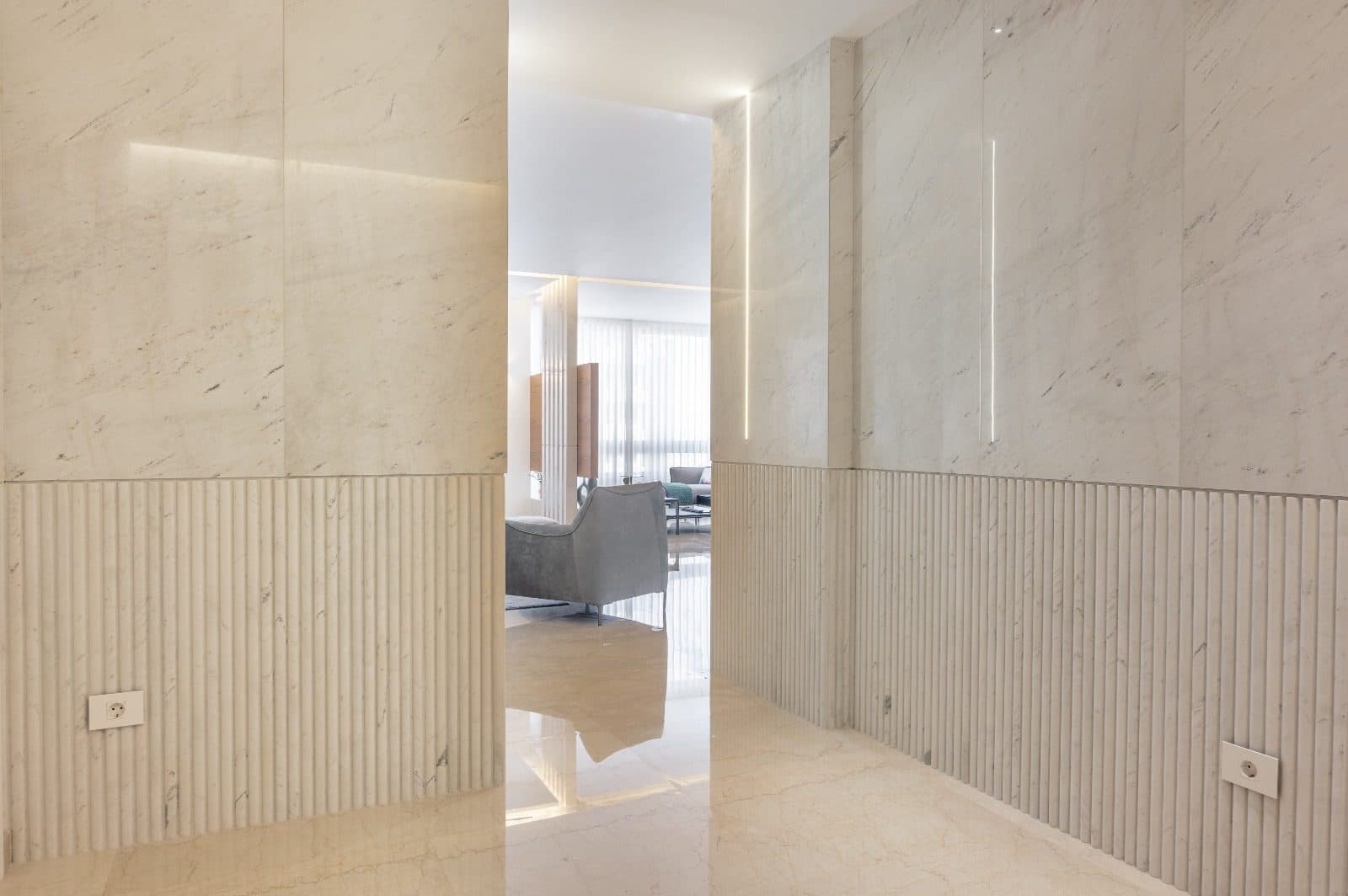
A marble floor is one of the few elements of a home that is both structural and decorative — you walk on it every day, yet it sets the tone for the whole room. The luxury rarely comes from a single rare slab. It comes from how the stone is cut, matched and laid: the pattern, the colour, the finish and the borders. Below are the flooring designs we are most often asked for, and how to choose between them. You can see the full range of our marble collection and pull samples in person at the showroom.
First, what marble actually is
Marble is a metamorphic rock — limestone recrystallised under heat and pressure — which gives it the flowing veins and depth that make it so prized underfoot. It is also porous and calcite-based, so it can stain if left unsealed and will etch (dull) on contact with acids such as wine, citrus or vinegar. None of this rules it out for floors; it simply means the stone should be sealed on installation, cleaned with pH-neutral products, and matched to how each room is used. Good design works with marble's nature rather than against it.
Book-matched flooring
Book-matching takes two consecutive slabs cut from the same block and opens them like a book, so the veins mirror across the join. On a floor it creates a large, symmetrical pattern — almost like a rug woven into the stone — and is the single most dramatic way to use a strongly veined marble.
Best for: entrance halls, formal living and dining rooms, hotel lobbies — any space large enough to read the full mirrored figure.
Chevron and herringbone
Both lay rectangular pieces at an angle to draw the eye along a room. In herringbone the ends are cut square and staggered; in chevron they are cut on a 45-degree angle so the points meet in a continuous V. The effect is movement and elegance without the floor feeling heavy.
Best for: hallways and corridors, bedrooms, and refined, gallery-like interiors where you want quiet detail rather than a bold statement.
Inlay and medallions
An inlaid floor sets smaller pieces of contrasting stone — or slim metal lines such as brass — into a marble field to form a pattern. A medallion is a circular or radial inlay, usually centred under a chandelier or at the heart of an entrance, where it anchors the room. This is the most bespoke option: every medallion is cut and fitted for its space.
Best for: grand entrances, stair landings and reception areas where a centrepiece is wanted.
Borders and framing
A border is a band of contrasting marble run around the edge of a room or to frame a central field. It is a restrained, classical device that defines the space, ties the floor to the architecture, and lets you introduce a second colour without committing the whole floor to it. A darker frame around a pale field is a timeless combination.
Best for: dining rooms, libraries and any room where you want to draw a clear edge or transition between zones.
Mixed-stone fields
Combining two or more stones in one floor adds depth and a sense of craft. The classic example is the checkerboard — alternating light and dark squares for graphic, traditional elegance — but mixing tones can be far subtler, layering closely related neutrals for warmth rather than contrast.
Best for: checkerboards in entrances and kitchens; soft multi-tone blends in living spaces that should feel warm and considered rather than bold.
Large-format slabs
Large-format flooring uses big slabs with as few joints as possible for a clean, seamless surface. Fewer grout lines make a room feel calmer and larger, and they show off a continuous run of veining. Large format and book-matching pair especially well together.
Best for: open-plan living areas and minimalist, contemporary interiors where you want the stone, not the joints, to be the story.
Choosing colour
Colour sets the mood of the whole floor:
- Whites and pale greys — classic whites with soft grey or gold veining feel bright, open and timeless, and reflect light into a room.
- Warm beiges and creams — neutral, forgiving tones that read as understated luxury and hide everyday wear well.
- Greens and golds — richly veined stones that add character and depth, ideal for a feature space or a smaller room.
- Blacks and deep tones — bold and architectural; dramatic as a full floor or, more commonly, as a contrasting border, medallion or checkerboard square.
Choosing a finish
The finish changes how a floor looks, feels and performs:
- Polished — a glossy, reflective surface that shows veining at its most vivid and amplifies light. The most luxurious look, but smoother underfoot and more apt to show etch marks.
- Honed — a smooth matte finish that is softer to the eye, more slip-resistant and more forgiving of light scratches and etching. A practical, contemporary choice for busy areas and bathrooms.
- Brushed or textured — a subtle tactile surface with the best grip, suited to wet rooms and covered outdoor areas.
How to choose the right design
When you are planning a marble floor, weigh four things together:
- The room and its scale — large patterns such as book-matching and medallions need space to read; pale stone and tighter patterns suit smaller rooms.
- Finish to match use — polished where you want drama and the traffic is light; honed or brushed in bathrooms, kitchens and high-traffic routes.
- Pattern and colour as a pair — a strongly veined stone usually wants a simpler layout; a calmer stone can carry a busier pattern such as herringbone or a checkerboard.
- Installation and sealing — proper levelling, joint work and sealing on day one are what keep a marble floor looking right for decades. This is craftsman's work, not a DIY job.
A note on heritage
Zein Group has worked with natural stone in Beirut since 1989, and we keep more than a hundred slabs in stock so colours and veins can be matched in person rather than from a photograph. Whether you are building, renovating, or working abroad on a project from Lebanon, the same principles apply: choose the pattern to suit the room, the finish to suit the use, and let the stone do the rest.
See it in person
The best way to choose a flooring design is to stand over full slabs and lay samples next to one another. Browse our marble collection, visit the showroom to see colours and finishes side by side, or contact us to talk through a specific floor and how it should be laid.
Frequently asked
- Is marble flooring durable enough for everyday use?
- Yes — marble has been used for floors for thousands of years and lasts for decades when it is sealed on installation and cared for. It is softer than granite and will etch on contact with acids, so it should be sealed, cleaned with pH-neutral products, and given a honed or brushed finish in the busiest or wettest areas.
- Which marble flooring pattern is the most luxurious?
- Book-matching and inlaid medallions tend to feel the most luxurious because they are bespoke and require skilled cutting and fitting. That said, a simple large-format floor in a beautifully veined stone can be just as striking — the right answer depends on the room and the effect you want.
- Should I choose a polished or honed finish for floors?
- Polished gives the most vivid, reflective, luxurious look but is smoother and shows etch marks more readily. Honed is matte, softer to the eye, more slip-resistant and more forgiving of wear. Many homes use polished in formal rooms and honed in bathrooms, kitchens and high-traffic routes.
- Can I combine different marbles in one floor?
- Yes. Mixed-stone floors — from a graphic black-and-white checkerboard to a soft blend of warm neutrals — add depth and craft. Contrasting borders and inlays are an easy way to introduce a second colour without committing the whole floor to it.
See it in the showroom.
Browse over a hundred natural stones as full slabs in Beirut, or ask our team for guidance on your project.
Keep reading